How to number invoices: rules, formats and mistakes to avoid
Why invoice numbers must be unique and sequential, the numbering formats that work, what to do about gaps and voided invoices, and how to start your first invoice number.
 Billairo team
3 min read
On this page
- Why invoice numbers matter
- The rules
- Common invoice numbering formats
- What number should your first invoice have?
- Gaps, cancellations and mistakes
- Should numbering restart every year?
- Let your software do it
- Frequently asked questions
- Do invoice numbers have to be consecutive?
- Can I use letters in invoice numbers?
- Can two invoices have the same number?
- Do quotes and credit notes use the invoice numbering?
Invoice numbers look like a small detail, but they're how you, your client and the tax authority keep track of every sale. Get the system right once and you'll never think about it again; get it wrong and you'll be explaining gaps and duplicates to an accountant.
Why invoice numbers matter
- Tracking: each payment can be matched to exactly one invoice.
- Your client's records: their accounts team files and pays invoices by number.
- Tax rules: in the EU and UK, VAT invoices must carry a unique, sequential number. Many other countries have similar requirements.
- Audit trail: a continuous sequence shows nothing has been left out of your books.
The rules
- Every number must be unique. Never reuse a number, even for a cancelled invoice.
- Numbers must follow a sequence. Each new invoice gets the next number. EU rules allow more than one series (for example one per shop or per year), as long as each series is continuous.
- Don't leave gaps. If a number is skipped, you should be able to explain why.
- Don't delete issued invoices. Cancel them with a credit note instead, so the number stays in your records.
Common invoice numbering formats
| Format | Example | Good for |
|---|---|---|
| Simple sequence | 0001, 0002, 0003 | Most small businesses |
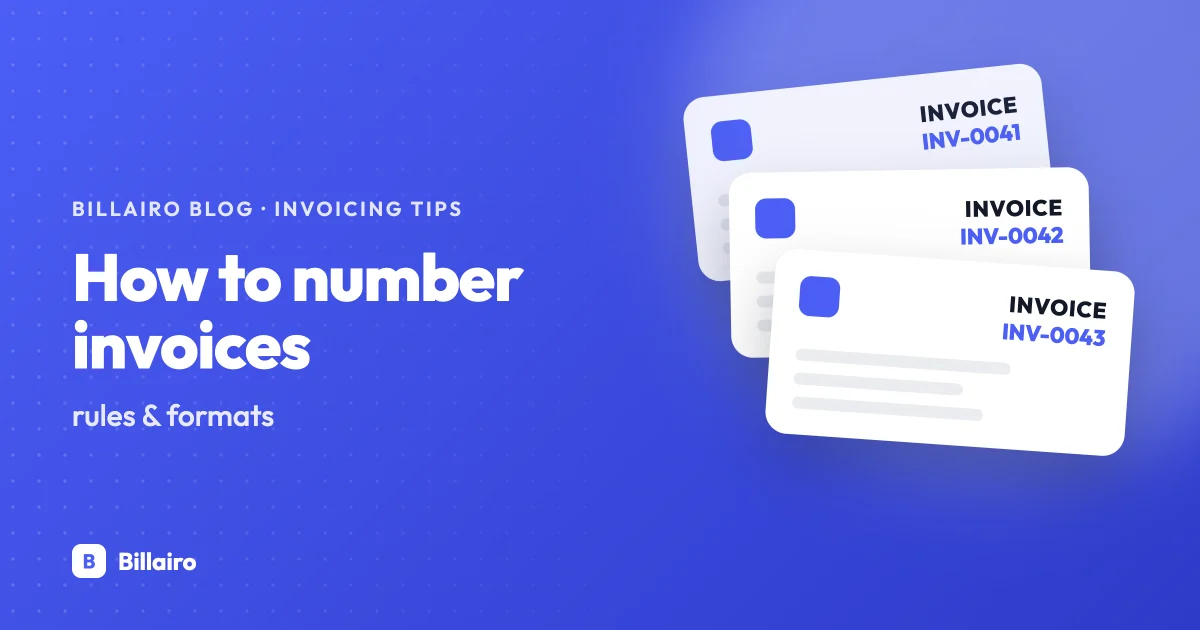
| Prefix + sequence | INV-0041 | Telling invoices apart from quotes (Q-0012) and credit notes (CN-0003) |
| Year + sequence | 2026-0041 | Seeing at a glance which year an invoice belongs to |
| Client code + sequence | ACME-007 | Few clients with many invoices each — but you still need a unique overall sequence |
| Project + sequence | WEB24-03 | Project-based work |
Keep it simple. A prefix and a padded number (INV-0001) is easy to read, sorts correctly and works everywhere. Pad with zeros so numbers sort properly: INV-0009 comes before INV-0010, whereas INV-9 sorts after INV-10.
About client-based numbering: numbering invoices per client (ACME-001, ACME-002, BETA-001…) creates many parallel series and duplicates across clients. If you like client codes, add them alongside a single overall sequence, not instead of it.
What number should your first invoice have?
You can start at 1 (INV-0001). Some businesses start at a higher number, such as 1001, so they don't look brand new — that's generally fine, as long as you continue the sequence from there. What matters is that the numbers that follow are unique and continuous.
Gaps, cancellations and mistakes
- You made a mistake on an issued invoice: don't edit or delete it. Issue a credit note that cancels it (fully or partly), then a new invoice with the next number.
- An invoice was created but never sent: if your system already gave it a number, void it and keep it on record rather than deleting it.
- A gap appeared by accident: write down why (for example a software error) and keep the note with your records.
- You switched invoicing tools: continue from the last number you used, so the sequence doesn't restart.
Should numbering restart every year?
It can, if your numbers include the year (2026-0001, then 2027-0001) — the year keeps them unique. If your numbers don't include the year, keep counting across years.
Let your software do it
Numbering by hand is where duplicates and gaps come from. Invoicing software assigns the next number automatically and won't let you reuse one. In Billairo, invoices are numbered INV-0001, INV-0002 and so on; drafts can be edited or deleted, but once an invoice is sent it's locked and corrected with a credit note (numbered separately as CN-0001…), so your sequence always holds up. You can try it with the free invoice generator or a free account.
Frequently asked questions
Do invoice numbers have to be consecutive?
For VAT invoices in the EU and UK, yes: they must follow a sequence that uniquely identifies each invoice. Several separate series are allowed, but each one must be continuous.
Can I use letters in invoice numbers?
Yes. Prefixes like INV- or a year are fine, as long as each full number is unique and follows the sequence.
Can two invoices have the same number?
No. Even if they're for different clients, each invoice from your business needs its own number.
Do quotes and credit notes use the invoice numbering?
No. Give them their own series (Q-0001, CN-0001) so your invoice sequence has no gaps.