
Invoicing for contractors and tradespeople: labour, materials, deposits and stage payments
How builders, electricians, plumbers and other trades should invoice: separating labour and materials, deposits, progress payments, retention, and a layout that gets approved first time.
 Billairo team
4 min read
On this page
- What makes contractor invoices different
- How to invoice labour and materials correctly
- Progress payments and milestone billing
- Deposits and retention
- Deposits
- Retention
- Recommended invoice layout for trades
- Common pitfalls
- Frequently asked questions
- Should I show material costs separately?
- How much deposit should a contractor ask for?
- When should I invoice on a long job?
- What is retention on a construction invoice?
Builders, electricians, plumbers, landscapers and handymen face invoicing problems an office freelancer never does: materials bought upfront, jobs that change halfway through, multi-week projects and clients who want everything itemised. A clear invoicing system protects your cash flow and avoids disputes.
What makes contractor invoices different
- Two kinds of cost. Your time (labour) and the things you buy (materials, parts, equipment hire), often with different markups and sometimes different tax treatment.
- Money goes out before it comes in. You often pay for materials weeks before the client pays you.
- Jobs change. Extra work, hidden problems and client changes are normal, and each needs agreeing and billing.
- Longer projects. Big jobs are billed in stages rather than one final invoice.
- A job site. The work often happens at an address other than the client's billing address.
How to invoice labour and materials correctly
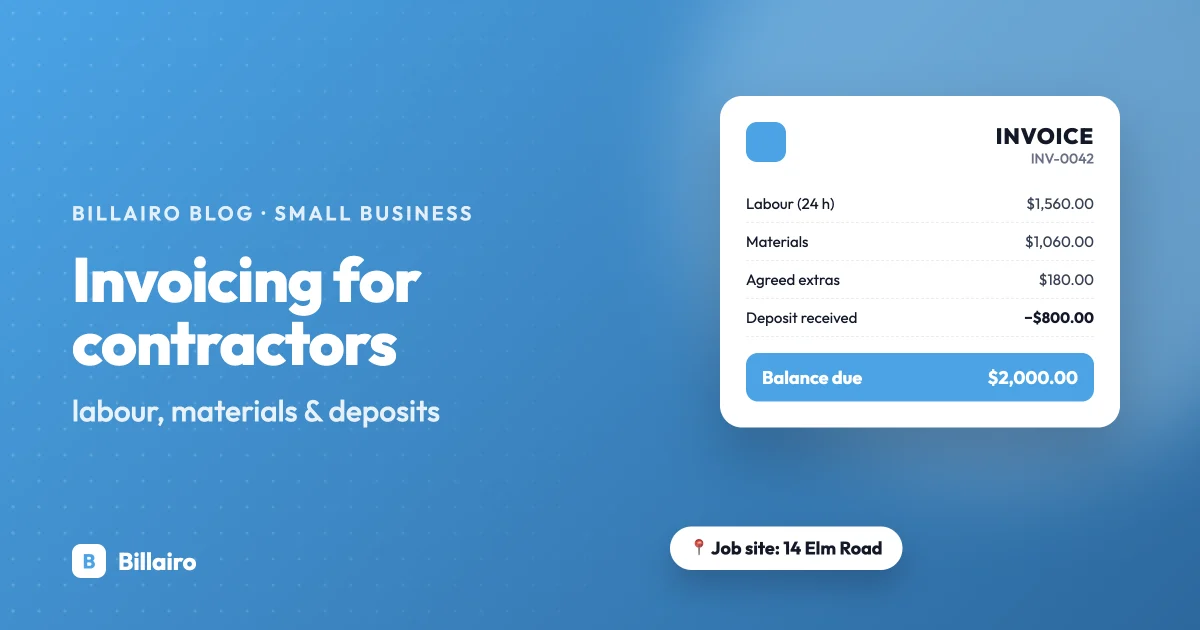
Show labour and materials as separate lines. Clients understand what they're paying for, and it makes disputes far less likely.
| Description | Qty | Rate | Amount |
|---|---|---|---|
| Labour — bathroom refit (2 people) | 24 h | $65.00 | $1,560.00 |
| Tiles, adhesive and grout | 1 | $640.00 | $640.00 |
| Vanity unit and taps | 1 | $420.00 | $420.00 |
| Waste removal (skip hire) | 1 | $180.00 | $180.00 |
- Labour: by the hour or day, or as a fixed price per task. Say how many people if it matters.
- Materials: itemise significant items; group small consumables into one line. Decide whether you show materials at cost plus a markup, or include your margin in the price — and be consistent.
- Extras: anything outside the original quote goes on its own line, ideally with a reference to when it was agreed ("Extra socket in kitchen, agreed 12 Nov").
Saving your common labour rates and materials as catalogue items means you pick them instead of retyping them. In Billairo, contractor businesses get units like hours, days and square metres set up from the start.
Progress payments and milestone billing
For jobs longer than a couple of weeks, don't wait until the end to get paid. Agree stages in the quote, for example:
- Deposit on acceptance (to cover materials)
- First fix complete
- Second fix complete
- Final payment on completion and sign-off
Invoice each stage as it's reached, and on each invoice show what the stage covers, the amount, and the running total against the full contract. That way the client — and you — always know where the job stands.
Deposits and retention
Deposits
A deposit covers your materials and secures the client's commitment. 20–50% is common, depending on how much you spend upfront. Invoice the deposit when the client accepts the quote, and deduct it on the final invoice so the balance is clear. In Billairo you can request a deposit from the quote; it's deducted from the final invoice automatically.
Retention
On larger commercial contracts, the client may hold back a percentage of each payment — often 3–5% — as retention, released after the work is finished and any defects are fixed. If your contract includes retention:
- Show the retention on each invoice, so it's clear what's being held back.
- Keep a running record of the total retained.
- Note the release dates in your calendar, and invoice the retained amount when it's due — it's easy to forget, and it's your money.
Retention is mainly a feature of bigger commercial work; most domestic jobs don't use it.
Recommended invoice layout for trades
- Your business name, logo, contact details and any trade registration numbers
- Client name and billing address
- Job site address, if different from the billing address
- Invoice number, date, due date and the quote or job reference
- Labour lines
- Materials lines
- Agreed extras
- Subtotal, tax and total
- Deposit and previous stage payments received, and the balance due
- Payment details and terms, plus warranty or guarantee information
Billairo adds a "Job site" address under the client's for contractor businesses, so it's always on the invoice. Browse our invoice templates for a layout that suits your trade.
Common pitfalls
- Doing extra work without a written agreement. Even a text message confirming the price before you start saves arguments later.
- Forgetting to bill materials bought during the job. Keep receipts together per job.
- Invoicing weeks after finishing. Invoice on the day, while the client is happy with the work.
- Vague lines like "Work as discussed — $4,800".
- No deposit on a big materials order, leaving you out of pocket if the job is cancelled.
- Not checking tax rules for construction. Some countries have special schemes for building work — for example the UK's Construction Industry Scheme and domestic reverse charge for VAT. Ask an accountant how they apply to you.
Need an invoice for a job right now? Use the free invoice generator, or start a free account to keep quotes, deposits and invoices for every job together.
Frequently asked questions
Should I show material costs separately?
Usually yes. Separate labour and materials lines make the invoice easier to approve and reduce disputes. Whether you show your markup is a business choice.
How much deposit should a contractor ask for?
Enough to cover your materials and some of your risk: 20–50% is common. For large jobs, combine a deposit with stage payments.
When should I invoice on a long job?
At each agreed stage, not just at the end. Put the stages and amounts in your quote before you start.
What is retention on a construction invoice?
A percentage of each payment the client holds back until the work is complete and defects are fixed, then releases. It's common on commercial contracts and should be shown clearly on each invoice.


