Invoice payment terms explained: Net 30, Net 14, due on receipt and more
What Net 30, EOM and 2/10 Net 30 mean, which terms get you paid fastest, and the exact wording to put on your invoices.
 Billairo team
4 min read
On this page
- What are invoice payment terms?
- Common payment terms and what they mean
- Which payment terms should you use?
- What's normal by type of business
- Are there legal limits on payment terms?
- How to write payment terms on an invoice
- How to get clients to pay on time
- Frequently asked questions
- Does Net 30 mean 30 days or one month?
- Is Net 30 counted from the invoice date or the delivery date?
- Can I change my payment terms for an existing client?
- What happens if a client ignores the payment terms?
Payment terms tell your client when and how you expect to be paid. They're a single line on an invoice, but they have more effect on your cash flow than almost anything else you put on it.
This guide explains the common terms, which ones get you paid fastest, and the wording to use.
What are invoice payment terms?
Payment terms are the conditions attached to an invoice: the deadline for payment, the accepted payment methods, and anything that happens if the deadline is missed (like a late fee) or met early (like a discount). Ideally you agree them before you start work — in a quote, contract or email — and then repeat them on every invoice.
Common payment terms and what they mean
| Term | What it means |
|---|---|
| Due on receipt | Payment is expected as soon as the invoice arrives. |
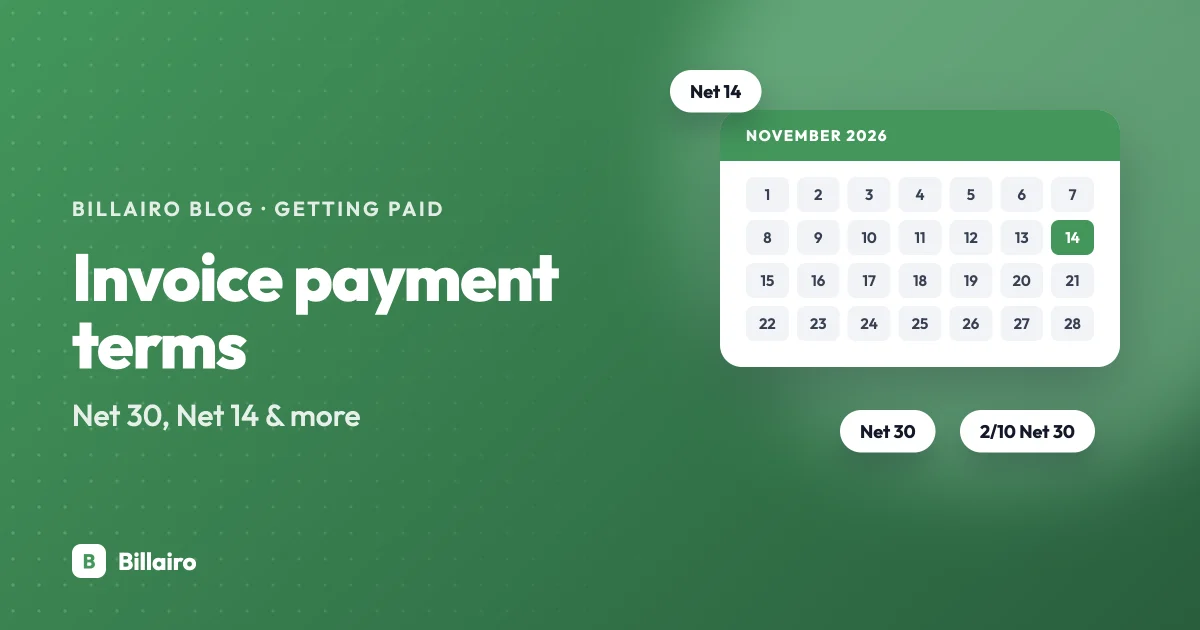
| Net 7 / Net 14 / Net 30 | Payment is due 7, 14 or 30 days after the invoice date. |
| Net 60 / Net 90 | Payment is due 60 or 90 days after the invoice date. Common with large corporations. |
| EOM (end of month) | Payment is due at the end of the month the invoice was issued. |
| Net 30 EOM | Payment is due 30 days after the end of the month of the invoice. |
| 2/10 Net 30 | The client can take 2% off if they pay within 10 days; otherwise the full amount is due in 30. |
| CIA (cash in advance) | Payment before the work starts or goods ship. |
| COD (cash on delivery) | Payment when the goods are delivered. |
| 50% upfront | Half before work starts, the balance on completion. Common for projects. |
| Stage payments | Payments at agreed milestones of a longer project. |
Which payment terms should you use?
There's no single right answer, but a few rules of thumb:
- Shorter terms get you paid sooner. Clients tend to pay close to the deadline, whatever it is. If you can choose, Net 14 rather than Net 30 roughly halves the time your money is tied up.
- Match your client's process. Large companies often run payments on a fixed cycle (say, Net 30 or Net 60) and can't make exceptions. It's better to know that upfront and plan for it than to chase.
- Ask for a deposit on bigger jobs. For projects over a few weeks, 30–50% upfront protects you if the client disappears halfway through. Billairo lets you request a deposit from a quote and deducts it on the final invoice automatically.
- Avoid "due on receipt" on its own. It sounds firm but has no date attached, so it often gets treated as "whenever". A specific date works better.
What's normal by type of business
- Freelancers and agencies: Net 7 to Net 14 for small clients, Net 30 for corporate clients, deposits on projects.
- Trades and contractors: deposits for materials, stage payments, then the balance on completion.
- Wholesale and B2B suppliers: Net 30 is standard; Net 60 or longer with big retailers.
- Retainers and subscriptions: invoice at the start of each period, due within 7–14 days. Recurring invoices automate this.
Are there legal limits on payment terms?
In some places, yes:
- European Union: under the Late Payment Directive, business-to-business payment terms should not exceed 60 days unless both sides expressly agree otherwise and it isn't grossly unfair to the supplier. Public authorities generally have to pay within 30 days.
- United Kingdom: if no terms are agreed, payment is due 30 days after the customer receives the invoice or the goods/services, whichever is later. Agreed terms of more than 60 days must be fair to both parties.
- United States: there's no general federal limit for private B2B contracts; terms are whatever you agree. Some states have prompt-payment laws for specific industries and for government contracts.
In the UK and EU you also have a statutory right to charge interest and compensation on late payments. We cover that in our guide to late payment fees.
How to write payment terms on an invoice
Be specific and put the due date in full. Some examples you can adapt:
Payment due within 14 days of the invoice date (by 28 November 2026). Please pay by bank transfer to the account below, quoting the invoice number.
Payment due by 31 December 2026 (Net 30). A 2% discount applies if paid within 10 days.
Payment due within 30 days. Late payments may incur interest and compensation under the Late Payment of Commercial Debts (Interest) Act 1998.
In Billairo, the due date is calculated for you, and your standard terms appear on every invoice automatically — or you can set them per invoice.
How to get clients to pay on time
- Agree terms before the work starts, in writing.
- Invoice immediately when the work is delivered.
- Put the due date on the invoice as a date, not just "Net 30".
- Make it easy to pay: bank details plus a card or PayPal link.
- Send reminders — a friendly one before the due date, then on the day, then after. Automatic reminders are the easiest way to stay consistent.
- Follow up personally if an invoice is more than a week or two late.
Frequently asked questions
Does Net 30 mean 30 days or one month?
Thirty calendar days from the invoice date, unless your terms say otherwise (for example "30 days from receipt" or "Net 30 EOM").
Is Net 30 counted from the invoice date or the delivery date?
Usually the invoice date. If you want it to run from delivery or receipt, say so in your terms.
Can I change my payment terms for an existing client?
Yes, but tell them in advance and apply the new terms to new work, not invoices already issued.
What happens if a client ignores the payment terms?
Send reminders, then a firmer letter. In the UK and EU you can add statutory interest and compensation; elsewhere you can charge a late fee if it was part of your agreed terms. As a last resort, small claims court is designed for exactly this.