How to invoice international clients: currency, tax, language and getting paid
Which currency to bill in, when to charge VAT or sales tax, how to handle exchange rates, and the cheapest ways to get paid by clients abroad.
 Billairo team
Updated 17 November 2026
5 min read
On this page
- 1. Choose the currency before you start
- 2. Handle exchange rates sensibly
- 3. Work out the tax
- 4. Invoice in the client's language
- 5. Choose how you'll get paid
- 6. Agree terms and protect yourself
- International invoice checklist
- Frequently asked questions
- Should I invoice in my currency or my client's?
- Do I charge VAT to clients in other countries?
- What's the cheapest way to receive payments from abroad?
- Can I send invoices in English to foreign clients?
Working with clients in other countries is one of the best ways for a freelancer or small business to grow. It also raises questions a local invoice never does: which currency, whether to charge tax, how the client will pay, and how much of the money arrives once the banks have taken their cut.
1. Choose the currency before you start
You have three options:
- Your currency. You know exactly what you'll receive; the client takes the exchange-rate risk. Simple, but some clients find it less convenient.
- The client's currency. Easier for the client to approve and pay, and often wins work. You take the exchange-rate risk and may pay conversion fees.
- A major third currency (usually US dollars or euros). Common in international freelancing, especially if you hold an account in that currency.
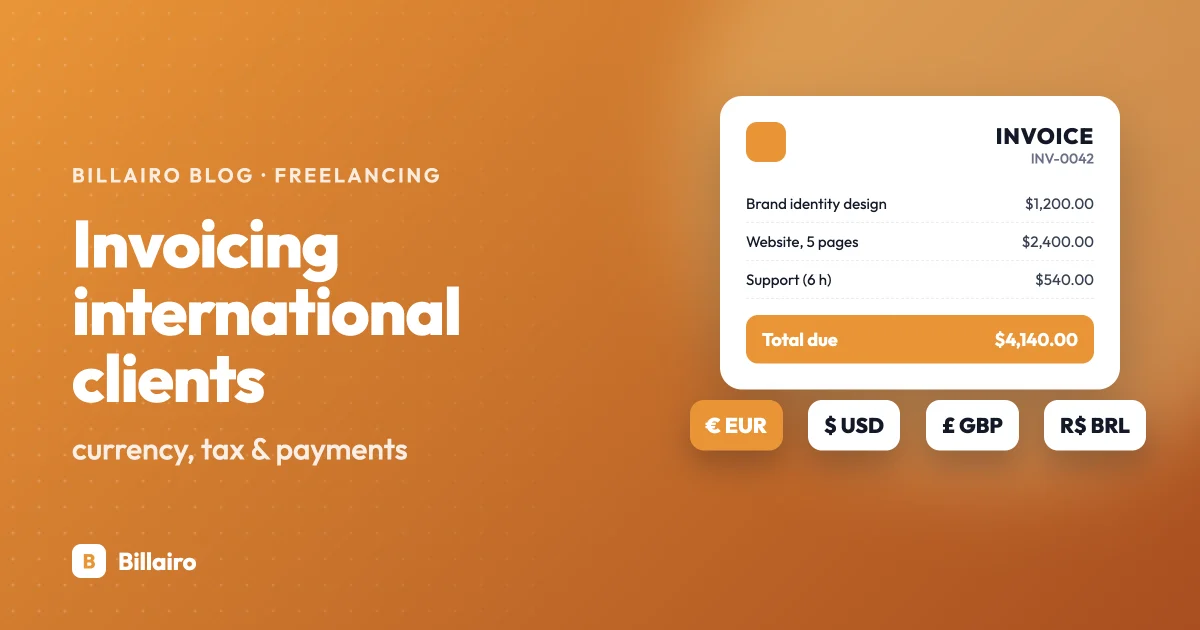
Whichever you choose, agree it in the quote or contract and put the currency code on the invoice (USD, EUR, GBP) — "$" alone could be US, Canadian or Australian dollars.
In Billairo, each client can have their own currency: their invoices use it automatically, and your reports keep each currency separate rather than mixing them.
2. Handle exchange rates sensibly
- If you quote in a foreign currency for a long project, consider a clause that lets you revise the price if the rate moves more than a set amount.
- For your own records, note the rate on the day you issue the invoice and the amount you actually received. Your accountant will want both.
- If you're VAT-registered and charge VAT on an invoice in a foreign currency, many countries require the VAT amount in your local currency as well.
3. Work out the tax
Tax on cross-border sales depends on where you are, where your client is, whether they're a business or a consumer, and what you sell. Some general patterns:
- Services to a business in another EU country: usually no VAT; the client accounts for it under the reverse charge. Put both VAT numbers and a reverse-charge note on the invoice. See our VAT invoice guide.
- Services to a business outside your country (UK, EU, many others): often outside the scope of your local VAT, so no VAT is charged — but check the rules for your specific service.
- Selling to consumers abroad: different rules apply, especially for digital products, and you may need to register for tax where the customer is.
- Freelancers outside Europe billing Europe or the US: you generally don't charge EU VAT or US sales tax on services. Your obligations are mostly at home: declaring the income and, in some countries, issuing a local tax document. In Brazil, for example, service exports have their own rules for NFS-e, which your accountant can confirm.
When no tax is charged, say why on the invoice — "Reverse charge", "Export of services" or "Outside the scope of UK VAT" — so the client's accountant doesn't query it.
4. Invoice in the client's language
An invoice your client's finance team can read gets approved faster. If you work with clients in Germany, France or Spain, consider sending invoices in their language, with dates and numbers in their local format (28.11.2026, 1.234,50 €). Billairo can send each client's invoices, reminder emails and online invoice page in their language — English, German, French, Spanish, Italian or Dutch — while you keep using the app in yours.
5. Choose how you'll get paid
International bank transfers through traditional banks can be slow and expensive, with fees deducted on both sides and a weak exchange rate. Better options:
| Method | Good for | Watch out for |
|---|---|---|
| Multi-currency account (e.g. Wise, Revolut Business, Payoneer) | Receiving USD, EUR, GBP like a local, converting at close to the market rate | Conversion and withdrawal fees vary by provider and currency |
| SEPA transfer | Euro payments within Europe: cheap and usually fast | Only for euros, within the SEPA zone |
| PayPal | Clients who already use it; small amounts | Higher fees and currency conversion margins |
| Card payment link (e.g. Stripe) | Clients who want to pay by card immediately | Card fees, often higher for international cards |
| International wire (SWIFT) | Large amounts, corporate clients that require it | Intermediary bank fees; agree who pays them |
Put clear instructions on the invoice: account holder name, IBAN or account number, SWIFT/BIC, and the bank's address for SWIFT transfers. Add "Please pay all bank charges" or agree to split them (the SWIFT options are OUR, SHA and BEN) so you don't receive less than you invoiced.
Adding pay links for PayPal, Stripe, Wise or Revolut to your invoices gives clients a one-click option. The money goes straight to your account.
6. Agree terms and protect yourself
- Get a written agreement covering scope, price, currency, payment terms and who pays transfer fees.
- Ask for a deposit on the first project with a new overseas client. Chasing a debt across borders is much harder than at home.
- Keep payment terms short and send reminders — time zones make it easy for invoices to slip.
International invoice checklist
- Currency code (USD, EUR, GBP…) agreed and shown on the invoice
- Your details and the client's full legal name and address, including country
- Client's VAT or tax number where relevant
- Tax treatment stated (VAT charged, reverse charge, export, or outside scope)
- Payment details for international transfers (IBAN, SWIFT/BIC) and/or pay links
- Who pays bank charges
- Due date as a full date, in an unambiguous format
Frequently asked questions
Should I invoice in my currency or my client's?
If you have a multi-currency account, invoicing in the client's currency (or USD/EUR) usually wins work and costs little. If not, your own currency removes exchange-rate risk.
Do I charge VAT to clients in other countries?
Often not for B2B services, but it depends on where you and the client are and what you sell. Check the rules for your country, and state the reason on the invoice when you don't charge it.
What's the cheapest way to receive payments from abroad?
Usually a multi-currency account that gives you local account details in the client's currency, so they can pay with a domestic transfer.
Can I send invoices in English to foreign clients?
Generally yes, as long as the client accepts it. Some countries require certain invoices to be available in the local language, so check if you're VAT-registered there.