VAT invoice requirements in the EU and UK: what to include, reverse charge and e-invoicing (2026 guide)
The details a VAT invoice must show, how to invoice EU business clients under the reverse charge, small-business exemptions, and where e-invoicing is now mandatory.
 Billairo team
5 min read
On this page
- What a VAT invoice must include (EU)
- Simplified invoices
- What a VAT invoice must include (UK)
- Reverse charge: invoicing EU business clients in another country
- If you're not VAT-registered
- Multiple VAT rates on one invoice
- E-invoicing: where it's mandatory in 2026
- VAT invoice checklist
- Frequently asked questions
- Can I issue a VAT invoice in a foreign currency?
- Do I need the customer's VAT number on every invoice?
- What happens if a VAT invoice is wrong?
- Is a PDF invoice an e-invoice?
Once you're registered for VAT, your invoices stop being just requests for payment: they're tax documents your clients rely on to reclaim VAT. Miss a required detail and a business client may not be able to deduct the tax — which means a request to reissue, and a delay in getting paid.
This guide covers the rules across the EU and the UK as they stand in late 2026, including the e-invoicing mandates now rolling out.
This is general information, not tax advice. VAT rules have national details and change regularly — check with your tax authority or accountant for your situation.
What a VAT invoice must include (EU)
Across the EU, the required details come from Article 226 of the VAT Directive. A full VAT invoice must show:
- The date of issue
- A sequential number that uniquely identifies the invoice (see how to number invoices)
- Your VAT identification number
- Your customer's VAT number, where they're liable for the tax — for example under the reverse charge or for intra-EU supplies of goods
- Your full name and address, and your customer's
- The quantity and nature of the goods, or the extent and nature of the services
- The date of supply (or of a payment on account), if it's different from the invoice date
- The taxable amount per VAT rate or exemption, the unit price excluding VAT, and any discounts not included in the unit price
- The VAT rate applied
- The VAT amount payable
- Where no VAT is charged, the reason — for example the exemption that applies, or "reverse charge"
Member states add their own requirements on top. France, for instance, requires late payment terms on B2B invoices; Germany requires the date of supply on every invoice (a note that it's the same as the invoice date is enough). If you invoice in several countries, set up each country's details once and let your invoicing tool apply them.
Simplified invoices
Many countries allow a simplified invoice for small amounts. The limit is set nationally — €250 including VAT in Germany, €100 in many other EU countries. It needs less detail — typically your details, the date, what was sold, the total and the VAT rate — but can't be used for cross-border or reverse-charge sales.
What a VAT invoice must include (UK)
The UK's rules (from HMRC's VAT Notice 700/21) are very similar. A full VAT invoice needs a unique sequential number, your name, address and VAT registration number, the invoice date, the time of supply if different, the customer's name and address, a description of each item with quantity and price, the VAT rate and the VAT amount per item, the total excluding VAT, any discount, and the total VAT. VAT must be shown in pounds sterling even if you invoice in another currency.
Retailers can issue a simplified VAT invoice for sales up to £250 including VAT.
Reverse charge: invoicing EU business clients in another country
When you sell services to a VAT-registered business in another EU country, you usually don't charge VAT. Instead, the customer accounts for it in their own country — the reverse charge. Your invoice should:
- Show your VAT number and the customer's VAT number (check it with the EU's VIES service)
- Charge 0 VAT on the relevant lines
- Include a note such as "Reverse charge: VAT to be accounted for by the recipient (Article 196, Directive 2006/112/EC)"
Goods shipped to a VAT-registered business in another member state are usually an intra-Community supply, also invoiced without VAT, with a reference to the exemption. Sales to customers outside the EU are usually treated as exports or outside the scope of EU VAT.
In Billairo you can set each client's tax treatment — standard, reverse charge, or no VAT (exports) — so their invoices get the right rates and wording automatically.
If you're not VAT-registered
Below your country's registration threshold you don't charge VAT, and you shouldn't show any. Several countries require a statement on the invoice explaining why:
- Germany: a reference to the small business rule (§ 19 UStG)
- France: "TVA non applicable, art. 293 B du CGI"
- Austria, Belgium, the Netherlands and others have similar wording for their small business schemes
Since 2025, EU small businesses can also use the small business exemption in other member states under the new cross-border SME scheme, subject to an EU-wide turnover limit — worth looking into if you sell across borders.
Multiple VAT rates on one invoice
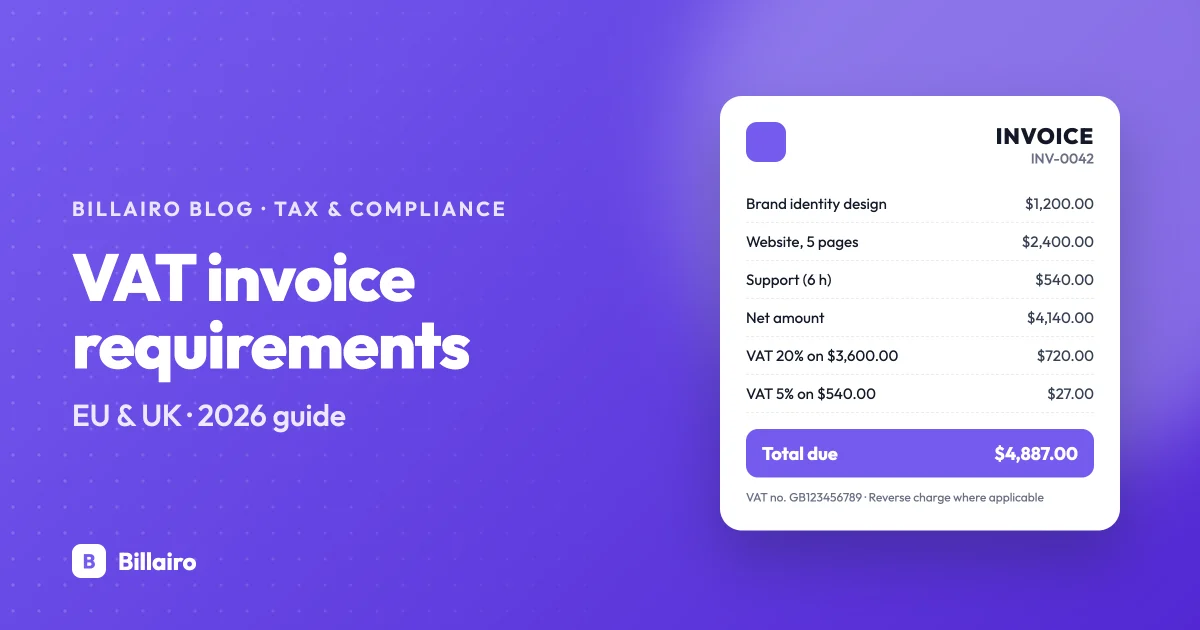
If you sell items at different rates (say, 20% and 5%), the invoice must show the taxable amount and VAT for each rate separately. A good invoicing tool handles this for you: set the rate on each line and it adds a breakdown per rate.
E-invoicing: where it's mandatory in 2026
Europe is moving from PDF invoices to structured e-invoices — machine-readable files that go straight into the customer's accounting system. Where things stand:
| Country | What's required |
|---|---|
| Germany | All businesses must be able to receive e-invoices since 1 January 2025. Businesses with turnover over €800,000 must issue them from 1 January 2027; everyone from 1 January 2028. Formats: XRechnung or ZUGFeRD (EN 16931). |
| France | All businesses must be able to receive e-invoices since 1 September 2026; large and mid-sized companies issue them now, and small businesses must issue them from 1 September 2027, through an approved platform. |
| Belgium | Structured B2B e-invoices via the Peppol network have been mandatory since 1 January 2026. |
| Poland | B2B invoices go through the national KSeF system, phased in during 2026, with the smallest businesses following in 2027. |
| Italy | All B2B and B2C invoices go through the SDI system (since 2019). |
| EU-wide | Under the "VAT in the Digital Age" package, e-invoicing becomes the standard for cross-border B2B sales from 1 July 2030. |
Billairo's Pro plan can produce ZUGFeRD / Factur-X PDFs and XRechnung files, which cover the German format and the hybrid format French clients can read. It doesn't send invoices through government systems like Italy's SDI, Poland's KSeF or France's approved platforms, so in those cases you'll need a certified provider.
VAT invoice checklist
- Unique sequential invoice number and date of issue
- Date of supply, if different
- Your name, address and VAT number
- Your customer's name and address (and VAT number for reverse charge or intra-EU sales)
- Description and quantity of goods or services
- Unit price excluding VAT, discounts, taxable amount per rate
- VAT rate(s) and VAT amount(s), in the local currency where required
- The reason if no VAT is charged (exemption, reverse charge, export)
- Any country-specific details (e.g. late payment terms in France)
Frequently asked questions
Can I issue a VAT invoice in a foreign currency?
Yes, but the VAT amount usually has to be shown in your national currency too — in pounds in the UK, and in euros (or the local currency) in EU countries that require it. Note the exchange rate you used.
Do I need the customer's VAT number on every invoice?
Only when they account for the VAT (reverse charge) or for intra-EU supplies of goods. For ordinary domestic sales it's not required, though some businesses ask for it.
What happens if a VAT invoice is wrong?
Don't edit it. Issue a credit note cancelling it (fully or partly) and a corrected invoice. Most EU countries require corrections to be made this way.
Is a PDF invoice an e-invoice?
Not in the legal sense. An e-invoice is structured data (like XRechnung XML). Hybrid formats such as ZUGFeRD and Factur-X embed that data inside a PDF, so they work as both.